
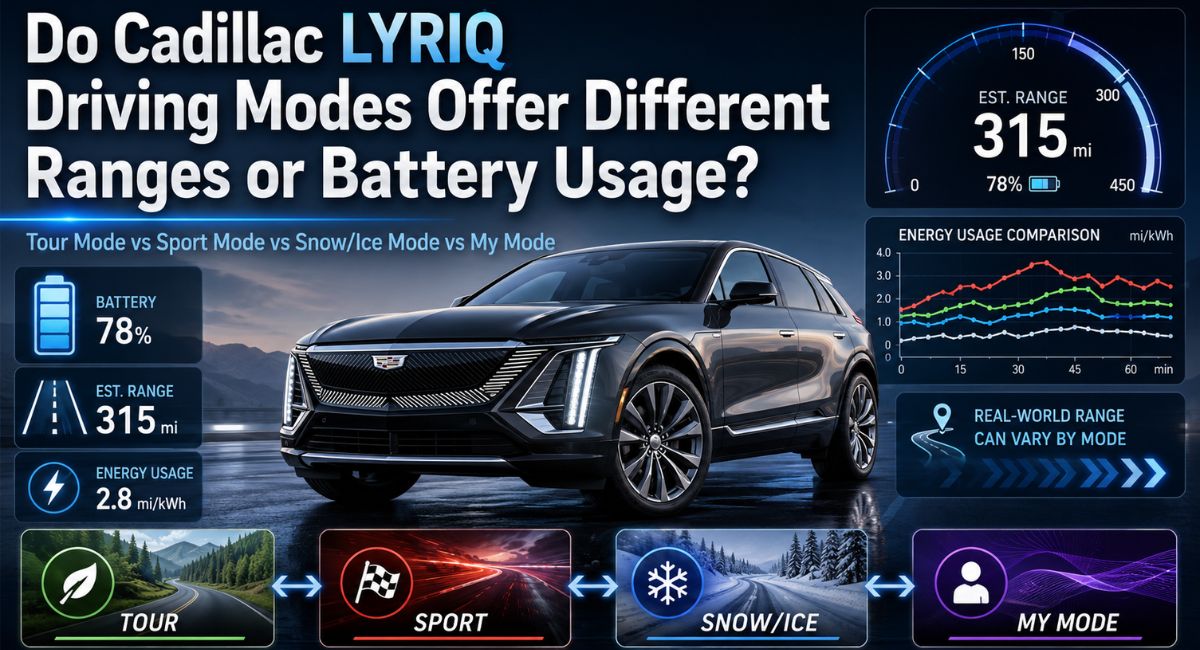
Do Cadillac LYRIQ Driving Modes Offer Different Ranges or Battery Usage?
You switch your Cadillac LYRIQ from Tour Mode to Sport Mode and notice that the displayed range estimate has fallen. This can create real range anxiety. You may worry that Sport Mode caused sudden battery drain, reduced the usable battery capacity, or damaged the high-voltage battery. Owners may also struggle to understand why Snow/Ice Mode, My Mode, and One-Pedal Driving appear to change energy use during different trips.
While reviewing Cadillac’s official guidance and the main causes of real-world energy consumption, I found that the selected driving mode is only one part of the answer. Driving speed, aggressive acceleration, cold weather, cabin heating, traffic, and terrain can have a greater effect. The modes change accelerator response, driving feel, and traction behavior, but they do not change battery size or create separate EPA range ratings. This guide explains how each mode may influence battery usage and how owners can compare results fairly.
Quick Answer: Do LYRIQ Driving Modes Change Range?
The Cadillac LYRIQ driving modes can indirectly affect the vehicle’s real-world range. However, they do not change its physical battery size or usable battery capacity. They also do not give the LYRIQ a separate official range rating for every mode.
Each mode changes how the vehicle responds. That response may encourage smooth or aggressive driving. As a result, it may affect energy consumption.
| Range or battery factor | Does the driving mode change it? |
| Physical battery size | No |
| Usable battery capacity | Normally no |
| Official EPA-estimated range | No separate rating for each mode |
| Accelerator response | Yes |
| Steering and handling feel | Yes |
| Traction behavior | Yes |
| Real-world battery consumption | Possibly |
| Dashboard range estimate | It may change with recent energy use |
| Actual trip range | It can change with behavior and conditions |
There is no reliable fixed percentage for the range loss caused by each mode. Claims such as “Sport Mode always reduces range by 10%” should not be accepted without controlled testing.
Understanding the Cadillac LYRIQ Driving Modes
The Cadillac LYRIQ is a luxury electric vehicle with selectable driving modes. These modes give the vehicle different driving characteristics. They may adjust steering, pedal response, braking feel, and traction settings.
The exact features can vary by model year, trim, drivetrain, and vehicle equipment. Therefore, drivers should check the owner’s manual for their specific LYRIQ.
The available modes can include:
- Tour Mode for normal driving
- Sport Mode for a sharper response
- Snow/Ice Mode for slippery roads
- My Mode for personalized settings
These modes do not act as separate battery maps with their own fixed range ratings. Instead, several vehicle systems work together. These include motor output, traction control, the climate system, and accelerator settings.
Cadillac LYRIQ Driving Modes at a Glance
| Driving mode | Main purpose | Possible effect on battery use | Best situation |
| Tour Mode | Balanced and comfortable response | May support calm driving | Daily travel |
| Sport Mode | Sharper and more responsive feel | May increase use during hard acceleration | Spirited driving |
| Snow/Ice Mode | Controlled power and improved traction | Winter conditions may increase use | Snowy or icy roads |
| My Mode | Personalized vehicle response | Depends on the selected settings | Customized driving |
The selected mode is only one part of the efficiency equation. Weather, speed, route, and driving habits may have a greater effect.
Tour Mode: Everyday Range and Efficiency
Tour Mode is designed for normal driving. It offers a balanced response for commuting, city travel, and highway use. Many drivers may find it to be the most natural setting for routine trips.
Tour Mode can support efficient driving because it does not focus on a performance-oriented response. However, selecting it does not guarantee maximum range.
Tour Mode works best with:
- Smooth accelerator inputs
- Moderate speeds
- Smooth driving
- Gentle braking
- Correct tire pressure
- Limited climate-control demand
A driver who uses frequent hard acceleration or travels at high highway speeds may still use a large amount of energy. Therefore, driver behavior remains important even in the same driving mode.
Sport Mode: Performance and Battery Consumption
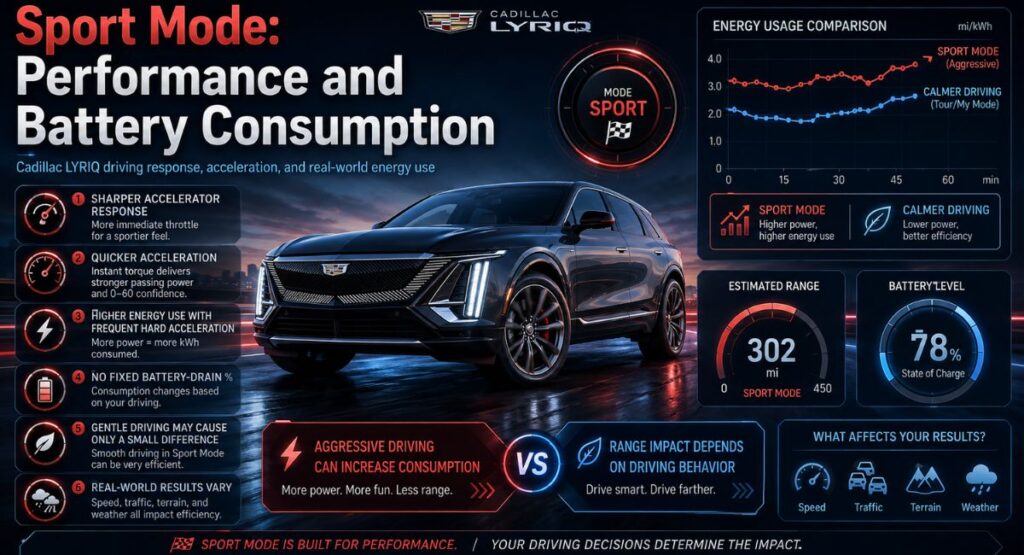
Sport Mode makes the Cadillac LYRIQ feel more responsive. The accelerator behavior may become sharper. This can support quicker acceleration and more engaging driving.
However, repeated hard acceleration requires more electrical energy. The Cadillac LYRIQ is a heavy luxury EV, so rapid acceleration may create a noticeable rise in battery consumption.
| Sport Mode driving pattern | Likely result |
| Gentle acceleration | A relatively small difference |
| Frequent rapid starts | Increased energy use |
| Repeated stop-and-go driving | Lower efficiency |
| Steady cruising | Smaller mode-related difference |
| Sustained high speed | Greater battery consumption |
| Spirited driving | Higher energy demand |
Sport Mode does not create a fixed battery-drain rate. A careful driver may notice only a modest difference. In contrast, frequent rapid acceleration can cause reduced efficiency and faster battery depletion.
Snow/Ice Mode: Traction Versus Efficiency
Snow/Ice Mode is intended for slippery road conditions. Its purpose is vehicle control, not range maximization. It changes the pedal response to provide smooth power delivery and help reduce unwanted wheel slip.
This mode can support driver control on:
- Snow-covered roads
- Icy roads
- Wet surfaces
- Roads with poor traction
Winter creates other energy demands. These may include:
- Reduced battery performance
- Greater use of cabin heating
- Poor tire conditions
- Increased rolling resistance
- Battery temperature control
- Difficult travel during a winter storm
A LYRIQ may show higher overall energy consumption during winter. However, that additional battery usage should not be blamed on Snow/Ice Mode alone.
My Mode: Custom Settings and Range Impact
My Mode creates a more personalized driving experience. Where supported, it allows drivers to adjust available settings based on their driver preferences.
Instead of using a single preset character, drivers can create a selected setting combination. Depending on the vehicle, these options may include accelerator response, steering feel, and braking response.
A calm response may encourage efficient driving. An aggressive setup may lead to frequent acceleration and increased energy consumption.
My Mode is a customization tool, not a dedicated range-saving mode. Its effect depends on:
- Selected settings
- Driver behavior
- Gradual acceleration
- Moderate speeds
- Smart climate-control use
- Current driving conditions
Therefore, My Mode offers driving flexibility rather than a guaranteed efficiency advantage.
Cadillac LYRIQ Tour Mode vs Sport Mode
Tour Mode and Sport Mode have different goals. Tour focuses on comfort and balance. Sport provides a sharper and more responsive feel.
| Feature | Tour Mode | Sport Mode |
| Pedal response | Balanced | Sharper |
| Daily comfort | High | More performance-focused |
| Rapid acceleration | Less encouraged | More engaging |
| Battery use | Often lower with calm driving | May rise with aggressive use |
| City travel | Good for routine driving | Useful for quick response |
| Long trips | Practical choice | Usable, but behavior matters |
| Fixed range difference | None | None |
Tour Mode is a sensible starting point for efficiency. It provides a balanced combination of comfort, response, and battery use.
However, smooth throttle behavior matters more than the mode name. Unnecessary acceleration bursts, temperature, traffic, tire pressure, and HVAC use can have a greater impact.
Do Drive Modes Change LYRIQ Battery Capacity?
No. Changing a drive mode does not increase or decrease the battery’s physical size. It also does not normally alter the usable battery capacity.
The battery-management system controls the battery’s safe operation. Drive modes mainly change the vehicle’s response to driver input.
| Battery or range term | Meaning |
| Battery capacity | The total energy the battery can store |
| Usable capacity | Energy available for normal vehicle operation |
| Battery percentage | Estimated charge remaining |
| Energy consumption | Energy used while driving |
| Displayed range | Predicted remaining travel distance |
| EPA-estimated range | Result from a standardized test |
A change in the displayed miles does not mean the battery’s capacity has changed. The vehicle may simply have updated its prediction.
Do LYRIQ Driving Modes Change the EPA Range?
The EPA range figure applies to a tested vehicle configuration. Cadillac does not publish a separate EPA number for every individual drive setting.
For the standard 2026 Cadillac LYRIQ, Cadillac lists these maximum figures:
| 2026 Cadillac LYRIQ configuration | Up to EPA-estimated range |
| Single-motor RWD | 326 miles |
| Dual-motor AWD | 319 miles |
These are not Tour Mode or Sport Mode figures. The official range may also depend on wheels, tires, trim, and equipment. Other model years and the LYRIQ-V may have different ratings.
Always check Cadillac’s specifications for the exact model year and configuration. Cadillac’s 2026 LYRIQ information provides the published maximum estimates.
Why the LYRIQ Range Estimate Changes
The displayed range estimate is dynamic. It is not a direct measurement of permanent battery health. The vehicle updates it by reviewing recent and current energy demand.
The estimate may change because of:
- Recent energy use
- Recent driving history
- Driving style
- Temperature
- Route conditions
- Traffic
- Elevation
- HVAC demand
- Vehicle load
- Changes in speed
For example, Sport Mode may encourage harder acceleration. The vehicle may then predict that the remaining energy will cover fewer miles.
A temporary estimated-range drop does not automatically show permanent battery degradation. The number may rise again after calmer driving or warmer conditions.
Switching Driving Modes While Driving
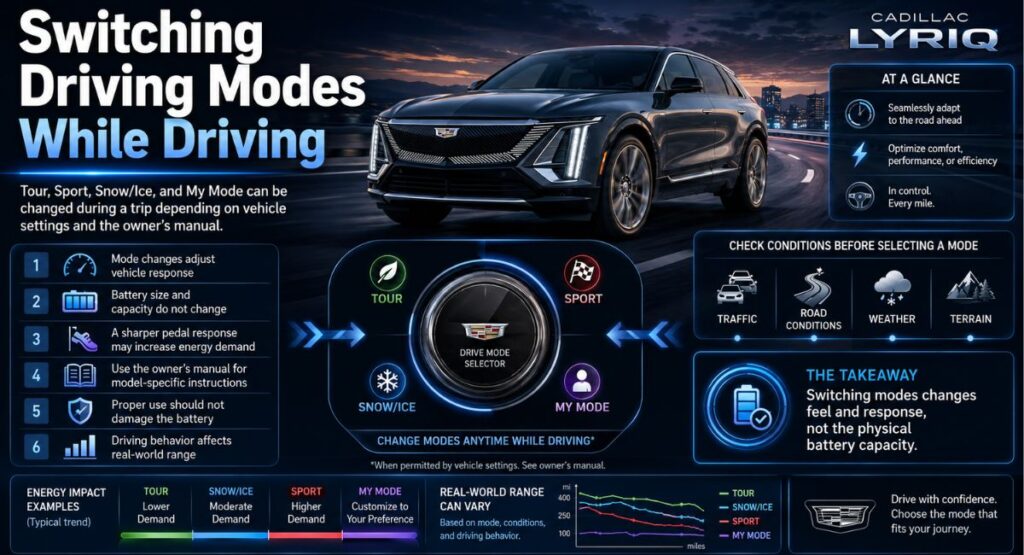
Drivers may be able to change modes during a journey. However, the correct process and available options can vary by vehicle. Follow the model-specific owner’s manual.
Changing from Tour Mode to Sport Mode should not damage the battery when the feature is used as directed. The vehicle’s control systems manage the motor output and battery operation.
However, the new response can change driving behavior. A sharper pedal may cause stronger acceleration and variable energy demand.
Regenerative Braking and LYRIQ Range
Regenerative braking turns some of the vehicle’s motion into electricity during deceleration. The vehicle stores part of this recovered energy in the battery.
Regeneration can improve efficiency. However, it cannot recover all the energy used during acceleration. Energy is also lost through heat, resistance, and other systems.
Drivers can improve energy recovery through:
- Traffic anticipation
- A steady driving pace
- Smooth deceleration
- Safe following distance
- Reduced frequent hard braking
These habits allow the electric powertrain to support more efficient operation.
One-Pedal Driving and Battery Efficiency
One-Pedal Driving allows drivers to control acceleration and much of the vehicle’s slowing with the accelerator pedal. When the driver lifts the pedal, the vehicle slows and captures energy.
This feature may improve efficiency when used smoothly. It can be useful in city traffic and stop-and-go conditions.
However, Cadillac does not recommend One-Pedal Driving on wet, snowy, or icy roads. Steep hills may also require more use of the brake pedal. This warning is important when using Snow/Ice Mode. Cadillac’s One-Pedal Driving guide explains these limits.
One-Pedal Driving does not recover every unit of energy used during acceleration. Smooth and steady driving remains more efficient than repeated acceleration and deceleration.
Regen on Demand
Regen on Demand is another regenerative feature. It uses a pressure-sensitive paddle on the steering wheel. The paddle helps the driver control how quickly the vehicle slows.
| Feature | One-Pedal Driving | Regen on Demand |
| Main control | Accelerator pedal | Steering-wheel paddle |
| Main purpose | Speed and deceleration control | Driver-controlled slowing |
| Energy recovery | Yes | Yes |
| Can work with the other system | Where supported | Where supported |
Drivers should become familiar with both systems before using them in busy traffic. Cadillac’s instructions and safety limits should always guide their use.
Cadillac LYRIQ RWD vs AWD Range
The drivetrain can affect range more than the selected mode. A dual-motor AWD model has different performance needs than a single-motor RWD model.
| Factor | RWD | AWD |
| Motors | Single motor | Dual motors |
| Driven wheels | Rear wheels | All wheels |
| Weight | Usually lower | Usually higher |
| Traction | Standard rear-wheel traction | Greater all-wheel traction |
| 2026 maximum EPA estimate | Up to 326 miles | Up to 319 miles |
Use the same model year, trim, and wheel size when comparing RWD and AWD. Otherwise, the comparison may be misleading.
What Affects Cadillac LYRIQ Real-World Range?
Drive modes are only one part of the efficiency equation. Several external factors can have a larger real-world impact on travel distance and miles between charges.
Acceleration and Driving Habits
Aggressive acceleration requires significant power. Frequent hard braking also wastes energy that regeneration cannot fully recover.
Use these habits to support improved efficiency:
- Apply smooth driving inputs.
- Use smooth acceleration.
- Maintain a steady speed.
- Leave a safe following distance.
- Avoid unnecessary stop-and-go movement.
A calm driving style may provide good efficiency even when the vehicle uses a responsive setting.
Speed and Highway Driving
Highway speed is one of the main factors affecting EV range. Aerodynamic drag rises as speed increases. The vehicle then needs more energy to maintain its speed.
A LYRIQ traveling at moderate highway speeds may use less energy per mile. Substantially higher speeds can create a larger range difference than changing the drive mode.
Environmental Conditions and Temperature
Environmental conditions and temperature affect EV performance. In cold weather, battery efficiency may fall. The vehicle may also use more energy for battery conditioning and cabin heating.
In hot weather, heavy air conditioning can cause increased consumption. Cabin preconditioning while connected to a charger may reduce battery demand after departure.
Terrain and Elevation Changes
Terrain and elevation changes affect consumption. Uphill climbing requires additional energy because the vehicle gains potential energy.
During descending, regenerative braking may capture some energy. However, it cannot recover all the uphill energy consumption.
A route with significant elevation changes may use more energy than a flat route, even with an identical driving mode.
Vehicle Weight, Wheels, and Tires
Vehicle setup also affects efficiency. Important factors include:
- Passenger and cargo weight
- Wheel size
- Tire pressure
- Seasonal tires
- Replacement tires
- Roof racks
- External accessories
- General tire conditions
Low tire pressure can increase resistance. Follow the pressure shown on the vehicle’s tire information label.
How to Compare Battery Usage Between Modes
There is no reliable universal percentage for range loss in each mode. A fair comparison requires controlled testing.
Use this method:
| Test step | What to keep the same |
| Route | Use similar routes |
| Conditions | Use similar conditions |
| Starting charge | Begin at a similar state of charge |
| Battery temperature | Start at a similar temperature |
| HVAC | Use the same settings |
| Speed | Maintain similar speeds |
| Vehicle load | Carry the same load |
| Measurements | Record miles per kWh and trip energy |
| Repetition | Complete at least two similar trips |
Use battery percentage only as a supporting measure. It may be rounded. Miles per kWh and total trip energy provide a more useful comparison.
Tour Mode can serve as a useful baseline for everyday efficiency. Then compare Sport, Snow/Ice, and My Mode under comparable driving conditions.
Understanding Cadillac LYRIQ Miles per kWh
Miles per kilowatt-hour shows how far an EV travels on one kilowatt-hour of energy. A higher result normally means better efficiency.
| Average efficiency | Energy needed for 100 miles |
| 2.0 miles/kWh | 50 kWh |
| 2.5 miles/kWh | 40 kWh |
| 3.0 miles/kWh | About 33.3 kWh |
| 3.5 miles/kWh | About 28.6 kWh |
The LYRIQ energy-consumption display can help with testing. However, a short trip may not provide enough information. Longer tests under stable conditions create more reliable consumption figures.
Which LYRIQ Mode Is Best for Maximum Range?
For most drivers, Tour Mode is the most practical starting point for balanced everyday efficiency. It offers a smooth response for routine travel.
Still, no mode guarantees the highest range in every situation.
| Driving situation | Practical mode |
| Daily commute | Tour Mode |
| City travel | Tour Mode |
| Long highway journey | Tour Mode with moderate speed |
| Spirited driving | Sport Mode |
| Slippery road | Snow/Ice Mode |
| Personalized response | My Mode |
| Efficiency comparison | Tour Mode as the baseline |
Safety should come before efficiency. Snow/Ice Mode provides improved control and controlled traction when roads become slippery.
Practical Ways to Maximize LYRIQ Range
Use these steps to reduce battery usage:
- Use gradual acceleration.
- Maintain a moderate speed.
- Avoid unnecessary high speeds.
- Anticipate traffic.
- Use regenerative features smoothly.
- Maintain correct tire pressure.
- Use battery preconditioning when appropriate.
- Precondition while connected to external power.
- Reduce unnecessary HVAC demand.
- Remove avoidable cargo.
- Plan efficient routes.
- Follow Cadillac charging recommendations.
- Follow Cadillac maintenance recommendations.
These actions may have a greater effect than simply selecting a different mode.
Battery Usage and Long-Term Health
Efficient driving may support lower energy use. However, efficiency and battery longevity are not the same issue.
The LYRIQ’s battery-management system monitors many operating conditions. Owners should follow the charging and maintenance guidance for their model year.
Charging Habits
Use the safest charging approach described in the owner’s manual. Select a charging level that fits everyday use and your travel needs.
Before a long journey, complete the required trip preparation. A suitable charge level gives the driver more travel flexibility.
Use fast charging according to Cadillac’s model-specific manufacturer guidance and the vehicle’s intended use.
Battery Preconditioning
Battery preconditioning may prepare the battery for charging or demanding temperatures. It can help the battery reach a suitable operating temperature.
Using preconditioning while connected to external power may reduce the battery energy used for temperature management after vehicle departure.
Regular Maintenance
Electric vehicles have fewer routine powertrain service items than conventional gasoline vehicles. However, they still need regular care.
Owners should check:
- Tires
- Brakes
- Cooling systems
- Software updates
- Tire pressure
- Other vehicle components
Proper maintenance supports vehicle performance, energy efficiency, and real-world efficiency. Follow Cadillac’s maintenance schedule and official instructions.
Common LYRIQ Range and Battery Myths
| Myth | Fact |
| Sport Mode always causes major battery drain | The result depends on speed and driver behavior |
| Tour Mode guarantees maximum range | Driving conditions still matter |
| Snow/Ice Mode causes all winter range loss | Temperature, heating, and road conditions may matter more |
| Regeneration returns all used energy | Some energy is always lost |
| Mode switching damages the battery | Proper use follows the vehicle’s control system |
| A lower displayed estimate proves battery damage | Recent energy use can change the estimate |
When High Battery Consumption May Signal a Problem
A changing estimate is often normal. However, a sudden rise in consumption under the same conditions may require attention.
Check for:
- Tire-pressure warnings
- Battery or charging warnings
- Unusual climate-control demand
- Changes in route or speed
- Extreme temperatures
- Unexpected battery-conditioning activity
- A sudden change on the same daily route
- Software messages
Contact an authorized Cadillac service center if abnormal consumption continues under comparable driving conditions.
Conclusion
The Cadillac LYRIQ driving modes can indirectly affect range, but they do not change the physical or usable battery capacity. Based on my review of Cadillac’s official guidance and established EV efficiency principles, one short journey or a changing displayed range estimate is not enough to judge a mode. A more reliable method is to compare the same route under similar conditions while recording miles per kWh, temperature, HVAC use, and driving speed. For most owners, Tour Mode offers balanced everyday efficiency, Sport Mode provides a sharper response, Snow/Ice Mode supports controlled traction, and My Mode allows personalized settings. Smooth acceleration, moderate speed, correct tire pressure, and guidance from the model-specific owner’s manual remain the safest ways to manage range.
FAQs
Do Cadillac LYRIQ driving modes change the battery range?
The modes can influence real-world energy consumption through vehicle response and driving behavior. However, they do not create different battery capacities or separate EPA range ratings.
Which LYRIQ driving mode is best for maximum range?
Tour Mode is a practical choice for maximum range and balanced everyday efficiency. However, smooth acceleration, moderate speed, and suitable climate-control use may matter more.
Does Sport Mode drain the LYRIQ battery faster?
Sport Mode may increase battery drain when it encourages frequent acceleration or aggressive acceleration. The actual result depends on driving behavior and road conditions.
Does Snow/Ice Mode reduce LYRIQ range?
Snow/Ice Mode may affect energy use, but winter temperatures, heating, slippery road surfaces, and reduced traction may have a greater effect on real-world range.
Can My Mode be configured to save battery?
A calm My Mode setup may support efficient driving. However, it does not guarantee lower battery consumption. The result depends on the settings and driver behavior.
Does changing drive modes alter battery capacity?
No. Changing the mode does not alter the physical or usable battery capacity. It only changes selected vehicle responses.
Does One-Pedal Driving improve LYRIQ range?
It may improve efficiency by recovering energy during deceleration. However, Cadillac does not recommend using it on wet, snowy, or icy roads.
Why does the estimated range change after selecting Sport Mode?
The estimate responds to recent energy use. If Sport Mode results in stronger acceleration, the vehicle may estimate a shorter remaining range.
Is the Cadillac LYRIQ more efficient with RWD or AWD?
The RWD model generally has the higher official range. For the standard 2026 LYRIQ, Cadillac lists up to 326 miles for RWD and up to 319 miles for AWD, depending on the configuration.