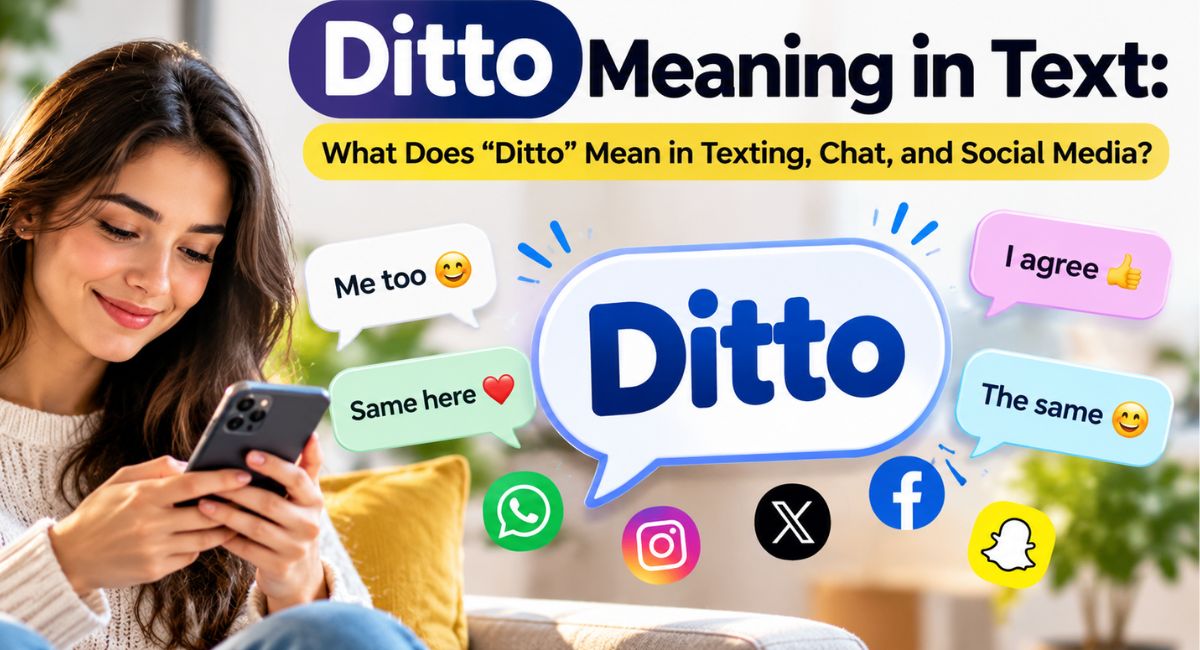
Ditto Meaning in Text: Uses, Examples, and How to Reply
Have you ever opened a text message and stopped at one simple word: “ditto”? It looks easy, yet it can leave you wondering what the person really means. Does it mean me too, I agree, or same here? In my review of dictionary definitions and real-world texting examples for this guide, I found that the confusion usually comes from one thing: context. The word itself is simple, but the message before it can change how the reply feels.
The ditto meaning in text is usually “the same as what was just said,” “me too,” or “I agree.” People use it in chat, social media, DMs, and other forms of digital communication to avoid repeating a full sentence. This guide explains the word in simple English, with clear examples, tone clues, grammar, history, and practical replies. It also explains when “ditto” is casual and when a fuller response works better.
What Does “Ditto” Mean in Text?
Quick Answer: Ditto Meaning in Text
In texting, ditto usually means “same,” “me too,” “same here,” or “I agree with you.” It tells the other person that the statement they just made also applies to you.
For example:
Person A: “I’m exhausted today.”
Person B: “Ditto.”
Here, “ditto” means:
“I’m exhausted too.”
It is a quick way to show agreement or a shared feeling without repeating the whole sentence.
The word can also mean that the same thing applies again. Dictionaries describe this wider sense as referring back to something already stated or avoiding repetition. Merriam-Webster lists “ditto” as an adverb, noun, verb, and adjective, while Oxford also records its use for repeated entries and its meaning of “the same.”
Ditto Meaning in Simple Words
In simple words, ditto means:
- Me too
- Same here
- I agree
- I feel the same
- The same thing applies to me
The exact meaning depends on the previous message.
Compare these examples:
“I love this song.”
“Ditto.”
Here, “ditto” means I love it too.
“That movie was terrible.”
“Ditto.”
Here, it means I agree; I also thought it was terrible.
“I chose the blue one.”
“Ditto.”
Here, it can mean I chose the same one.
So, the word does not always express emotion. Sometimes it simply points to the same thing.
What “Ditto” Can Mean Depending on Context
The easiest way to understand “ditto” is to look at the previous statement.
| Previous message | “Ditto” usually means |
| “I’m so tired today.” | I’m tired too. |
| “I love this song.” | I love it too. |
| “That was a bad idea.” | I agree. |
| “I miss our old school days.” | I miss them too. |
| “I picked the blue one.” | I picked the same one. |
| “Have a great weekend!” | Same to you / likewise. |
The word often works like a shortcut. Instead of typing a whole sentence, the speaker uses one word to point back to something already mentioned.
Is “Ditto” the Same as “Me Too” or “Same Here”?
Often, yes.
In everyday texting, ditto, me too, and same here can all show that the speaker shares the same feeling, opinion, or experience.
There is a small difference in style:
- Ditto = compact and slightly playful
- Me too = very natural and direct
- Same here = casual and clear
- Likewise = more formal or polished in some situations
- I agree = direct and explicit
The meaning may overlap, but the tone can be different.
The Main Meanings of “Ditto” in Texting
“I Agree”
One common use is simple agreement.
“I think this restaurant is overpriced.”
“Ditto.”
The reply means:
“I agree with you.”
This use is common when two people already share the same opinion.
“I Feel the Same Way”
“Ditto” can also show an identical emotional response.
“I’m nervous about tomorrow.”
“Ditto.”
That means:
“I feel nervous too.”
This is why “ditto” can be useful in emotional conversations. It can confirm a shared feeling without repeating the original statement.
“Me Too” or “Same Here”
Sometimes there is almost no difference between ditto and me too.
“I want pizza tonight.”
“Ditto.”
This means:
“Me too.”
The word is especially useful when the speaker wants a short response.
“The Same Thing Applies to Me”
“Ditto” can also mean that the same condition, plan, choice, or experience applies to the second person.
“I’m working late tonight.”
“Ditto.”
That means:
“I’m working late too.”
In this sense, the word points back to the first person’s situation.
“Repeat the Same Information”
The broader dictionary sense is about repetition. “Ditto” can refer to something already stated instead of writing it again.
Merriam-Webster defines the noun as a thing mentioned previously or above and notes that it can be used to avoid repeating a word. Its verb use can also mean to repeat or imitate something.
How “Ditto” Works in a Text Conversation
When Someone Replies With Just “Ditto”
A one-word “Ditto” reply usually means:
“I feel the same.”
“I agree.”
“Same here.”
The best interpretation comes from the message before it.
“I can’t wait for Friday.”
“Ditto.”
The speaker is not copying your words. They are saying they have the same reaction.
When “Ditto” Refers to an Opinion
If someone gives an opinion, “ditto” can show agreement.
“That new update made the app worse.”
“Ditto.”
The reply means:
“I think so too.”
When “Ditto” Refers to a Feeling
When the original message describes an emotion, “ditto” can confirm a shared feeling.
“I’m stressed about my exams.”
“Ditto.”
It means:
“I’m stressed too.”
The answer is short, but the emotional meaning comes from the original statement.
When “Ditto” Refers to a Plan, Choice, or Action
“Ditto” can also refer to plans or choices.
“I’m going to the event Saturday.”
“Ditto.”
This may mean:
“I’m going too.”
Another example:
“I ordered the large size.”
“Ditto.”
Here, it can mean:
“I ordered the same size.”
Why Context Changes the Meaning
The word ditto points backward. It depends on what came before it.
Look at these three examples:
“I love this movie.” → “Ditto.”
Shared opinion
“I’m exhausted.” → “Ditto.”
Shared feeling
“I bought the blue version.” → “Ditto.”
Same choice
The word stays the same. The context supplies the missing information.
Real Texting Examples of “Ditto”
Example of “Ditto” After an Opinion
Person A: “I think the ending was confusing.”
Person B: “Ditto.”
Meaning:
“I think the ending was confusing too.”
Example of “Ditto” After an Emotional Statement
Person A: “I’m really worried about tomorrow.”
Person B: “Ditto.”
Meaning:
“I’m worried too.”
Example of “Ditto” After a Compliment
Person A: “You looked great today.”
Person B: “Ditto!”
Depending on the conversation, this may mean:
“You looked great too.”
A compliment can make the exchange sound warm, but the word alone does not prove a romantic intention.
Example of “Ditto” About Plans or Choices
Person A: “I’m taking the morning train.”
Person B: “Ditto.”
Meaning:
“I’m taking the same train.”
Example of “Ditto” in a Group Chat
Person A: “We need a break after this project.”
Person B: “Ditto.”
Person C: “Same here.”
Here, several people are expressing the same shared experience.
Example of “Ditto” in Social Media Comments
Comment: “This song hits differently at night.”
Reply: “Ditto.”
The reply shows agreement with the commenter’s reaction.
Example of “Ditto” in Workplace Chat
Coworker: “That meeting could have been an email.”
Reply: “Ditto.”
This is casual workplace communication. It may work in a relaxed team chat, but a fuller sentence may be clearer in formal communication.
What Does “Ditto” Mean on Social Media?
Ditto in Instagram DMs
In Instagram DMs, “ditto” can act as a quick reply.
“I’m glad we finally caught up.”
“Ditto.”
The person means:
“I’m glad too.”
Ditto in TikTok Comments
In TikTok comments, a user may write “ditto” after someone shares an opinion or reaction.
“This part always makes me laugh.”
“Ditto 😂”
The emoji adds a humorous or playful signal.
Ditto in WhatsApp Chats
In WhatsApp chats, “ditto” can replace a longer sentence.
“I’m too tired to go out tonight.”
“Ditto.”
Meaning:
“I’m too tired too.”
Ditto in Group Conversations
In a group chat, one person may write “ditto” to show that the same statement applies to them.
“Anyone else ready for the weekend?”
“Ditto.”
“Same!”
It can help several people respond without repeating the same idea.
Ditto in Online Comments and Replies
Across online comments and replies, “ditto” usually acts as a compact form of agreement.
Its meaning remains linked to the statement it follows. The platform changes, but the basic function stays the same.
What Does “Ditto” Mean in Different Tones?
Casual and Friendly Tone
“Ditto” is often casual, friendly, and relaxed.
“I need coffee.”
“Ditto.”
The response sounds natural among friends or in casual chats.
Warm or Supportive Tone
A warm context can make “ditto” sound supportive.
“I’m glad we talked today.”
“Ditto.”
Here, the word confirms the other person’s feeling.
Playful or Humorous Tone
A funny message can make “ditto” playful.
“I have absolutely no idea what I’m doing.”
“Ditto 😂”
The emoji helps show the intended tone.
Romantic or Affectionate Tone
“Ditto” can appear in romantic or affectionate conversations.
“I miss you.”
“Ditto ❤️”
In this case, the context makes it affectionate.
However, “ditto” itself does not automatically mean romance.
Dry, Brief, or Dismissive-Sounding Tone
A one-word reply can sometimes feel dry or too brief.
“I spent all night working on this project.”
“Ditto.”
The reply is not necessarily rude. But in a serious conversation, the other person may expect more detail or support.
Why Punctuation and Emojis Can Change the Tone
Punctuation and emojis can add emotional context.
Compare:
“Ditto.”
“Ditto!”
“Ditto 😊”
“Ditto ❤️”
The basic idea stays the same, but the presentation changes.
- A period can feel neutral or brief.
- An exclamation mark can feel more enthusiastic.
- A smiling emoji can make the reply warmer.
- A heart can make it more affectionate.
These are clues, not fixed rules. Context still matters most.
Is “Ditto” Romantic?
When “Ditto” Can Express Affection
“Ditto” can express affection when it responds to an affectionate message.
“I really miss you.”
“Ditto ❤️”
The reply can mean:
“I miss you too.”
When “Ditto” Is Completely Non-Romantic
Romance is not required.
“I hate waking up early.”
“Ditto.”
“That restaurant was expensive.”
“Ditto.”
Both are ordinary examples of agreement.
How the Previous Message Reveals the Intended Meaning
The message before “ditto” is often the most useful clue.
Look at:
“I miss you.” → “Ditto.”
This can sound affectionate.
But:
“I’m tired today.” → “Ditto.”
Usually describes a shared feeling without any romantic meaning.
Examples of Romantic vs Friendly “Ditto”
| Conversation | Likely meaning |
| “I miss you.” → “Ditto ❤️” | Shared affection |
| “I love this song.” → “Ditto!” | Shared opinion |
| “You look great.” → “Ditto!” | Could return the compliment |
| “I’m exhausted.” → “Ditto.” | Shared feeling |
| “That movie was awful.” → “Ditto.” | Agreement |
The key is to avoid reading too much into one word.
Is “Ditto” Slang, Informal, or Standard English?
Is “Ditto” Considered Slang?
No. Ditto is not simply modern internet slang.
It is an established English word with dictionary entries dating back centuries. Dictionary.com traces it to the early 17th century, from Italian detto, while Merriam-Webster records first-known uses for its different grammatical forms beginning in the 1600s and 1700s.
It is common to use it in casual conversations, including texting.
Is “Ditto” Informal?
The conversational use of “ditto” is often informal. Oxford labels its adverb use as informal, and Cambridge also treats the common conversational use as informal.
That does not mean the word is incorrect or slang. It simply means the style may be too casual for some formal situations.
Can “Ditto” Be Used in Professional Communication?
Yes, but context matters.
A team member might write:
“I agree with the proposal.”
“Ditto.”
That can work in a relaxed internal chat.
For a formal client email, a clearer response such as “I agree” or “I feel the same way” may be better.
Ditto Grammar, Spelling, and Usage
How to Write “Ditto” Correctly
The standard spelling is:
ditto
It is normally written in lowercase unless it begins a sentence or appears in a title.
The pronunciation is commonly represented as /ˈdɪtoʊ/ in American English. Merriam-Webster gives the pronunciation “dit-oh.”
Can “Ditto” Stand Alone as a Reply?
Yes.
“I’m ready for a break.”
“Ditto.”
Merriam-Webster gives a very similar example and explains that the reply means the previous statement also applies to the speaker.
“Ditto!” vs “Ditto.”
Both are correct.
The difference is mostly tone.
“Ditto!” can sound more energetic.
“Ditto.” can sound calmer or more neutral.
In text messages, the punctuation can affect how the response feels, even though the basic meaning stays the same.
Common Expressions Such as “Ditto That”
“Ditto that” is a more expressive form of the same idea.
“I think we should leave early.”
“Ditto that.”
The speaker strongly agrees with the previous statement.
Use it mainly in informal communication.
The Noun and Adverb Uses of “Ditto”
“Ditto” has more than one grammatical role.
As an adverb, it can mean “as before,” “likewise,” or that the same statement applies.
“I enjoyed the first event, and ditto the second.”
As a noun, it can refer to something already mentioned or a ditto mark.
Merriam-Webster also records verb and adjective uses.
The Origin and History of the Word “Ditto”
What Does the Italian Word “Detto” Mean?
The word ditto comes from the Italian detto, meaning “said” or “aforesaid.”
The word ultimately comes from Latin dictus, the past participle of dicere, meaning “to say.”
How “Ditto” Entered the English Language
The word entered English centuries ago. Dictionary.com gives its first recorded use as 1615–25, while Merriam-Webster lists the first known use of its different grammatical forms from the 17th and early 18th centuries.
So, “ditto” is much older than modern texting.
Ditto in Lists, Records, and Bookkeeping
Historically, “ditto” helped avoid writing the same information again in lists, records, accounts, and other documents.
Oxford describes it as a word used under another word or phrase to show that the information is repeated.
For example, a list might contain:
Apples — $2
Oranges — 〃
Bananas — 〃
The symbol tells the reader that the same value continues.
The Development From Repetition to Agreement
The connection between repetition and agreement is easy to understand.
First, “ditto” could mean:
“The same thing as above.”
In conversation, that idea can naturally become:
“The same applies to me.”
That gives us the common modern reply:
“I agree.”
“I feel the same.”
“Me too.”
How the Meaning Reached Modern Digital Communication
Modern digital communication did not create the word. It simply gave the old word a fast new setting.
A text message can replace:
“I completely agree with what you just said.”
with:
“Ditto.”
This makes it useful in short messages, DMs, comments, and casual online conversations.
Ditto vs Similar Words and Replies
Ditto vs Me Too
Me too is very natural when the speaker shares a feeling, activity, or experience.
“I’m hungry.”
“Me too.”
Ditto can do the same job, but it points more directly back to the earlier statement.
Ditto vs Same Here
Same here clearly means that the speaker is in the same situation or feels the same way.
“I’m tired.”
“Same here.”
“Ditto” is similarly brief.
Ditto vs Likewise
Likewise often means “the same to you” or “in the same way.”
“Have a great day!”
“Likewise.”
It can sound more polished than “ditto” in some settings.
Ditto vs Same
Same is very common in casual texting.
“I need a vacation.”
“Same.”
“Ditto” can communicate the same idea, but it has a slightly different feel because it explicitly points back to what was said.
Ditto vs I Agree
I agree is the most direct option.
“That plan makes sense.”
“I agree.”
“Ditto” is shorter and less explicit.
When to Use Each Expression
| Expression | Main meaning | Typical tone |
| Ditto | Same / previous statement also applies | Casual |
| Me too | Same feeling or experience | Neutral/casual |
| Same here | Same situation or feeling | Casual |
| Likewise | Same to you / similarly | More formal |
| I agree | Clear agreement | Neutral |
No option is correct in every situation. Choose based on the context, audience, and tone.
How to Respond When Someone Says “Ditto”
Simple Replies
A simple “ditto” does not always need a long response.
You can reply:
- “Same!”
- “Exactly.”
- “I know, right?”
- “Totally.”
Friendly Replies
For a friendly conversation:
“Haha, glad we agree!”
Or:
“We’re definitely on the same page.”
Funny Replies
If the conversation is playful:
“Copycat 😂”
Or:
“Original thoughts only, please.”
These replies work when both people are clearly joking.
Supportive Replies
When someone shares a real feeling, you may want to respond with more than one word.
“I feel the same. We’ll figure it out.”
That can create a stronger sense of support than simply repeating “ditto.”
Romantic or Affectionate Replies
If the original conversation is clearly affectionate, you can respond warmly.
“I feel the same ❤️”
This removes some of the ambiguity of a one-word response.
When No Reply Is Necessary
Sometimes “ditto” simply closes the exchange.
For example:
“I’m ready for lunch.”
“Ditto.”
There may be nothing else to add.
Common Misunderstandings About “Ditto”
Does “Ditto” Mean Copying?
Not always.
In a text conversation, “ditto” usually means same, me too, or I agree.
However, the broader word also has meanings related to repeating, imitating, and copying. Merriam-Webster lists those senses under its verb usage.
Does “Ditto” Always Mean Agreement?
No.
It often communicates agreement, but it can also mean that the same thing, choice, condition, or information applies again.
Does “Ditto” Always Sound Friendly?
No.
It is often friendly or neutral, but the surrounding tone matters.
A very short “Ditto.” can sometimes sound dry. An emoji or exclamation mark can make it feel warmer.
Does “Ditto” Always Have a Romantic Meaning?
No.
Romantic meaning comes from the surrounding conversation, not from the word itself.
“Ditto” after “I miss you” may sound affectionate.
“Ditto” after “I hate Mondays” is simply agreement.
Does “Ditto” Mean the Same Thing in Every Context?
No.
The word has several related dictionary senses. In texting, the most common sense is agreement or a shared feeling. In lists and records, it can indicate repetition.
Can Using “Ditto” Sound Too Brief?
Yes.
The word is efficient, but efficiency is not always the goal.
If someone shares important news, a fuller reply may show more empathy and attention.
When Should You Use “Ditto”?
Good Situations for Using “Ditto”
“Ditto” works well when:
- You are having a casual conversation.
- You want to show agreement quickly.
- You share the same feeling.
- You want to avoid repetition.
- The other person will understand the reference.
Situations Where “Ditto” May Sound Too Informal
Use more care in:
- Formal emails
- Academic writing
- Official documents
- Important client communication
- Serious messages where more explanation is needed
The issue is usually not that the word is “wrong.” The issue is register and clarity.
Better Alternatives for Formal Messages
Instead of:
“Ditto.”
You may write:
“I agree.”
Or:
“I feel the same way.”
Or:
“I agree with your point.”
These make your meaning more explicit.
How to Choose Between “Ditto,” “Me Too,” and “I Agree”
Think about the goal of your response.
Use ditto for a short, casual echo.
Use me too when you share a feeling or experience.
Use I agree when you want to clearly state agreement.
This simple choice can make your communication sound more natural.
“Ditto” in Modern Digital Communication
Why Short Replies Are Common in Texting
Texting encourages short responses.
People often want to acknowledge a message without typing the whole idea again. Words such as same, me too, and ditto make that easy.
Ditto in DMs, Comments, and Messaging Apps
You may see “ditto” in:
DMs, comments, group chats, WhatsApp, Instagram, TikTok, and other messaging spaces.
The basic function remains the same: point back to the previous statement.
How Emojis Add Emotional Context
An emoji can change the feel of a short message.
“Ditto 😭”
can show a shared emotional reaction.
“Ditto 😂”
can show humor.
“Ditto ❤️”
can suggest affection.
The emoji adds information that the single word does not provide.
Why One Word Can Replace a Full Sentence
“Ditto” is useful because it compresses a longer response into one word.
Instead of:
“I feel exactly the same way you do.”
a person can simply write:
“Ditto.”
That is one reason the word fits modern fast communication.
Frequently Asked Questions About Ditto Meaning in Text
What does “ditto” mean in texting?
Ditto usually means “same,” “me too,” or “I agree.” It tells the reader that the previous statement also applies to the person replying.
What does “ditto” mean in chat?
In chat, “ditto” usually means that the speaker agrees or shares the same feeling, opinion, experience, or choice.
What does “ditto” mean in a text message?
It means the same as what was just said. For example, “I’m tired” → “Ditto” means “I’m tired too.”
Is “ditto” the same as “me too”?
Often, yes. Both can show a shared feeling or experience. “Ditto” can also have the broader sense of repeating or referring to something already mentioned.
Is “ditto” rude or polite?
“Ditto” is not rude by itself. It is usually casual. In an emotional or serious conversation, however, a one-word reply may feel too brief.
Is “ditto” slang?
Not exactly. Ditto is an established English word. Its use in casual texting is informal, but the word itself is not a newly created internet abbreviation.
Can “ditto” be romantic?
Yes, it can be used in a romantic conversation. However, romance comes from the surrounding message and relationship, not from the word alone.
Can I use “ditto” in a professional email?
It can work in a relaxed workplace exchange, but a clearer phrase such as “I agree” is often better for formal or client-facing email.
What does “ditto” mean after a compliment?
It can mean “same to you” or return the compliment.
“You look great today.”
“Ditto!”
The exact meaning depends on the conversation.
What does “ditto” mean when someone says “I miss you”?
It usually means “I miss you too.” The affectionate tone comes from the original message and the surrounding relationship.
How should I reply when someone texts “ditto”?
You can reply with “Same!”, “Exactly,” or a fuller sentence. The best response depends on whether the conversation is casual, funny, supportive, or affectionate.
Is “ditto” outdated?
No. The word is old, but it remains in current English use. Modern examples continue to show it in ordinary writing and conversation, while texting has given it another short-response use. Merriam-Webster’s current entry includes recent examples as well as its historical uses.
What Is a Ditto Mark?
A ditto mark is a symbol used to show that information should be repeated from above.
The symbol is commonly written as:
〃
Oxford lists 〃 as the symbol associated with ditto and explains that it shows a repeated entry. Dictionary.com defines ditto marks as two small marks used to indicate repetition.
This use is different from sending “ditto” as a casual text reply, but both uses share the same basic idea:
the same thing again.
What Is the Plural of “Ditto”?
The common plural is:
dittos
Merriam-Webster lists dittos as the plural noun form. Dictionary.com also records dittos and dittoes as plural forms.
The verb also has the forms:
dittoed
dittoing
Merriam-Webster documents these forms under the verb entry.
How Do You Spell “Ditto” Correctly?
The correct spelling is:
ditto
Common mistakes include:
dito
diddo
didto
When writing the word, use ditto.
“Ditto” the Word vs Ditto the Pokémon
Ditto can also refer to the Pokémon character.
That is a completely different meaning.
When someone asks about ditto meaning in text, they are usually asking about the English word used in a conversation, not the Pokémon.
Final Takeaway: Understanding “Ditto” From Context
After reviewing dictionary definitions, historical records, and modern text messages for this guide, the most useful lesson is simple: do not interpret “ditto” in isolation. The word usually means same, me too, or I agree, but it points back to the message before it. That previous statement tells you whether the reply refers to an opinion, feeling, plan, choice, or another piece of information. This is why two identical “ditto” replies can have very different meanings.
From a language-use perspective, “ditto” is also more than a piece of texting slang. It is an established English word with a long history. Dictionaries document its uses as an adverb, noun, verb, and adjective, as well as the ditto mark used to show repetition. Its history goes back to Italian detto, meaning “said” or “aforesaid.”
So, when you see “ditto” in a chat, DM, comment, or casual conversation, start with the simplest reading: “the same applies to me.” Then check the context, tone, punctuation, and emotional context before reading anything deeper into it. That approach gives you a more accurate understanding than guessing from one word alone. And when you use “ditto” yourself, match it to the situation: it works naturally in casual conversation, while I agree, me too, or a complete sentence may be clearer in more formal settings.